A displayed parking rate does not describe every visit. The actual charge may depend on duration, arrival time, validation, event rules or the date you leave. If parking is part of a commute, model the visit before counting the price as settled. The card brand does not determine the operator’s pricing.
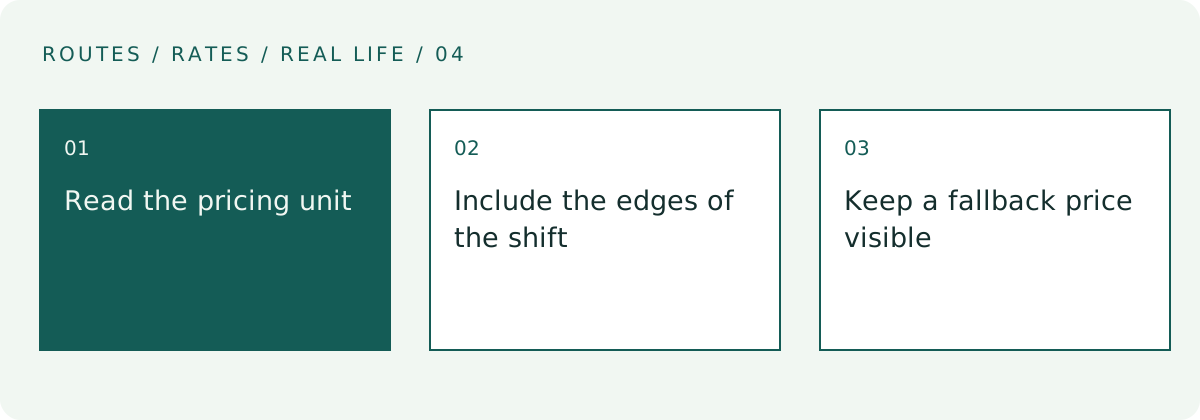
Read the pricing unit
A rate per hour, a daily maximum and an early-arrival special answer different questions. Check whether partial hours round up and what “day” means. An overnight shift can cross a pricing boundary even when the total time parked resembles a daytime shift.
Consider a fictional garage charging $4 per started hour with a $16 daily maximum. A three-hour-and-ten-minute visit reaches $16 under those invented rules. It is not $12.67, because the billing unit is a started hour. A real operator may use a different interval or maximum, so do not apply this example without checking.
Include the edges of the shift
Arrival before work and time needed to leave the workplace belong in the parking duration. Do not use scheduled paid hours as a substitute for the actual parking interval. If a special rate requires entry before a cutoff, allow for the fact that a late arrival may change the charge.
Ask whether a maximum resets at midnight, after a fixed number of hours or under another rule. Verify whether a quoted price includes taxes and mandatory fees. A reservation can have its own cancellation conditions, which may differ from drive-up parking.
Keep a fallback price visible
Write the expected price and the price if a relevant condition is missed. For example, a hypothetical $10 early rate and $18 ordinary maximum create an $8 difference. That does not mean the higher price will occur; it shows what the plan depends on.
Finish with the operator’s current terms, the relevant timestamps and any unresolved condition. Do not enter card details into an unrelated rate-comparison page. This publication explains how to read the structure of a price, not how to validate a parking transaction or guarantee space availability.
Continue the comparison
Agree on the carpool unit before discussing the amount
Price a fallback you could actually use
Method and scope
This is an original worked planning guide. All amounts, schedules and providers in its examples are fictional unless a source is explicitly identified. The calculations explain relationships, not a personalized financial recommendation. No private account or provider payment flow was tested.