A backup commute is useful only if it is available at the relevant time and can complete the necessary journey. “Take another ride” is not a complete plan. If you depend on a regular commute, identify the fallback’s conditions before treating its cost as known.
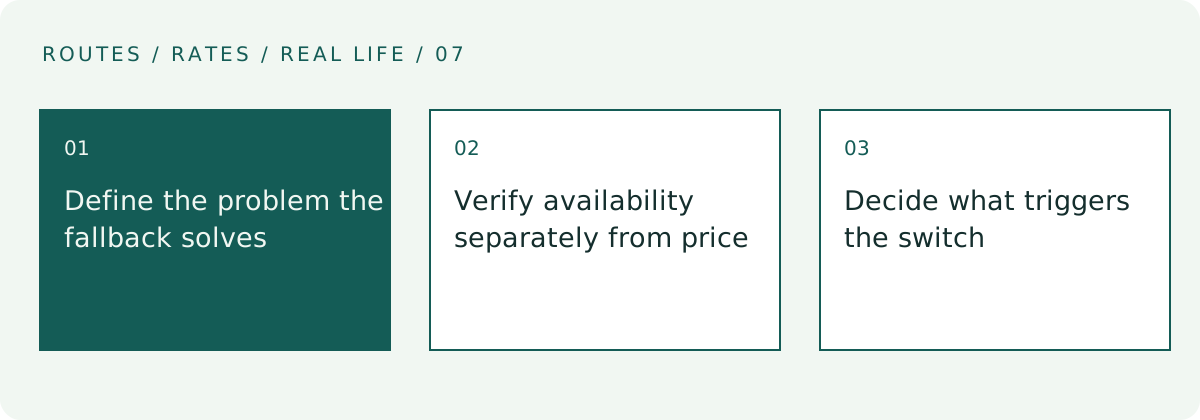
Define the problem the fallback solves
A missed outward bus, a late finish and a car unavailable for several days are different problems. Choose one scenario at a time. Name the origin, destination, required arrival window and any accessibility or equipment needs privately. This publication does not collect those details or provide live routing.
An invented plan might use a $5 ordinary round trip and a $22 one-way fallback after a late finish. A day using the ordinary outward journey for $2.50 plus that fallback would total $24.50 under the example assumptions. It would not be $27 unless both ordinary fares were actually paid and nonrefundable.
Verify availability separately from price
A past quote does not guarantee a future ride. Local operating hours, pickup rules and service coverage matter. Ask the appropriate provider about the relevant conditions and keep uncertain prices labeled as estimates. A friend’s possible availability is not a confirmed service.
Check whether the fallback requires advance registration or another payment method. Do not assume that Fintwist or any particular prepaid card will be accepted for every booking. Verify directly with the provider and your card terms rather than relying on this editorial example.
Decide what triggers the switch
Write a practical decision point, such as a confirmed cancellation or a time after which the ordinary route cannot meet the need. Do not wait until a theoretical alternative is no longer usable. The trigger should reflect the actual situation, not an arbitrary rule from an article.
Review the plan after using it: which assumption was wrong, what cost was actually incurred and what should change? Keep only the useful lesson, not a permanent log of every movement. A fallback is a bounded response to a specific disruption, not a promise that any amount of planning can eliminate travel uncertainty.
Continue the comparison
Reprice the commute when the shift pattern changes
Find the break-even point before buying a pass
Method and scope
This is an original worked planning guide. All amounts, schedules and providers in its examples are fictional unless a source is explicitly identified. The calculations explain relationships, not a personalized financial recommendation. No private account or provider payment flow was tested.